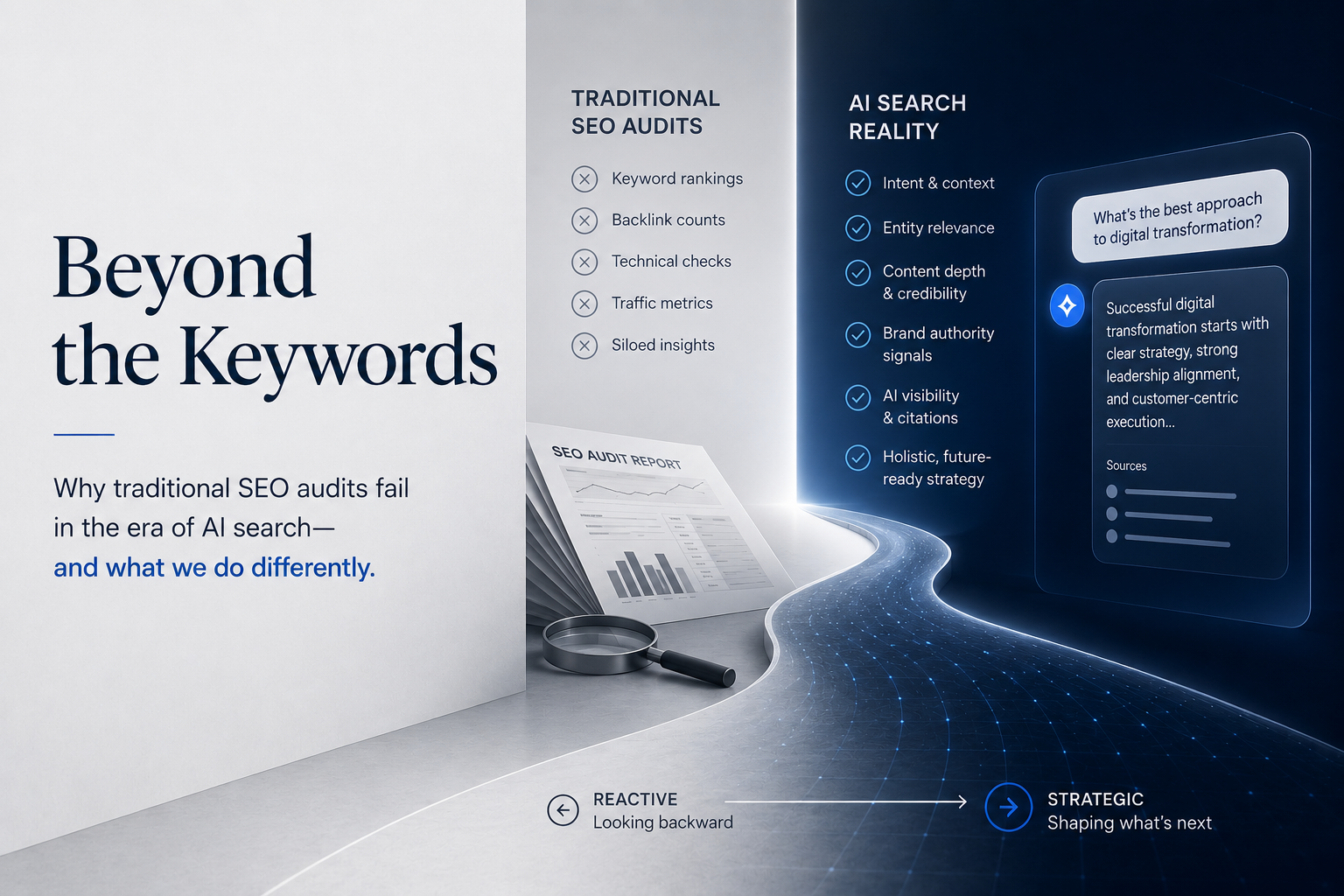
In the modern digital landscape, traditional SEO audits no longer provide the clarity high-consideration businesses need. Search engines have evolved into answer engines that use retrieval-augmented generation. These systems do not simply index keywords. They build multi-dimensional graphs of entities, verify data integrity, and evaluate intent alignment before deciding whether to recommend a business.
When a website contains structural friction in its technical layer, answer engines default to recommending competitors instead. At Clarity Digital Advisory, we saw a clear gap in the market for an engineering-grade diagnostic. That is why we developed the Clarity Core Assessment Framework. The sections below explain what sets this approach apart and where conventional tools fall short.
1. Mathematical Cohesion
Most digital marketing audits rely on fragmented tools that collect data at different times. This often produces internal contradictions. A marketing agency may deliver a report stating visibility is strong, while internal engineering logs show significant crawl issues.
A Clarity audit runs on a unified data pipeline. Every technical layer, baseline score, and 90-day projection is reconciled to a single source of truth before any advisor reviews the findings. We generate one unalterable record, complete with a reproducibility hash, so the summary provided to leadership matches the technical detail delivered to the development team. This alignment forms the foundation of the assessment.
2. Real-User Rendering
Many high-value sites use advanced security layers that block automated crawlers. Standard SEO tools are often treated as malicious traffic and stopped at the perimeter, resulting in incomplete or misleading reports.
Clarity audits use real-user behavioral rendering. The process mimics how an actual browser interacts with the site, executing page requests at human speed with rotating system signatures. This allows the assessment to analyze how answer engines would interpret the entity layer in real time, including content behind protective layers.
3. Developer Hand-Off Forensics
A common failure point in technical audits is the gap between findings and execution. An agency may report schema issues or duplicate identifiers, then leave the internal team to locate the problems across templates and plugins.
The Clarity Core Assessment includes a Page-by-Page Schema Forensics Log. When entity collisions or conflicting records are detected, the report isolates each issue to the exact URL path. Broken code variants are shown side by side, accompanied by a clear, step-by-step remediation path. Development teams receive a direct roadmap rather than a list of problems to investigate.
4. Revenue-Critical Intent Alignment
Traditional audits often emphasize broad traffic metrics while overlooking whether the site can answer the specific questions that influence buying decisions. A Clarity Core Assessment maps the site against a tailored set of must-win queries organized into three layers:
- Commercial queries that reflect high-intent buyer needs
- Objection queries that address common concerns about pricing, support, fit, and risk
- Comparison queries that test how clearly the site differentiates against alternatives
When objections or differentiation points exist only in generic paragraphs rather than structured, machine-readable sections, answer engines often bypass the business entirely. The assessment identifies the precise semantic and structural gaps that reduce recommendation frequency on revenue-critical prompts.
How This Supports Recommendation Readiness
A Clarity audit is designed for two audiences: executives who need to understand why their digital presence is underperforming with AI systems, and technical teams who need precise instructions to correct it. The deliverable separates commercial impact from technical remediation, turning fragmented data into a stable foundation for consistent recommendations.
If you want to see the exact data picture your site is currently projecting to answer engines, the Clarity Core Assessment provides that view along with a prioritized 90-day remediation plan.