If this is how businesses in our own sector are structured, imagine what your website looks like to AI.
We recently audited ten sites in our own competitive category - AI visibility and AI search optimization providers, using the same framework that we apply to client engagements. The results were instructive. The majority scored below50/70 on combined entity clarity and signal integrity. One platform that markets automated schema generation as its core product carried over 100duplicate @id conflicts on its own domain, the exact problem its product claims to solve. Another, which explicitly teaches Answer Engine Optimization, had zero structured data of any kind across its entire site. We mention this only to point out that the AEO provider that you’ve seen on YouTube or LinkedIn, may not be practicing what they’re selling.
This isn’t a rhetorical jab. It's the premise of this guide. There’s a lot of noise online about AI search right now. Every business seems to have a solution, and hundreds of millions of dollars in PE and VC funding are flowing into the market as companies race to capture share. What our audit data shows, again and again, is that many of those companies are not practicing what they sell. We think that gap is worth naming plainly, because it changes how you should evaluate everything in this space.
Owners, founders, CMOs, and CROs are asking the same questions. “How do I get my business recommended?” “How do AI models make these decisions?” “How do we know whether our website answers the questions potential customers ask AI?” and “How can we become the default recommendation in our field?”
At Clarity, we provide independent advisory in AI search. Do we have a point of view? Yes - of course we do. We also offer AI search products and services. But we recognize that other products and services can be genuinely valuable, provided their limitations are clearly understood. We are not, and don’t wish to be “mass-market”. We deliberately limit the number of clients we take on each month so each one gets the attention they deserve.
Therefore, this article is written for buyers evaluating these products and services. It is intended as a practical guide to the landscape, not a sales pitch. You may decide to work with us after reading it, or you may not. Either way, we hope you gain value from it, if you’re wrestling with this problem.
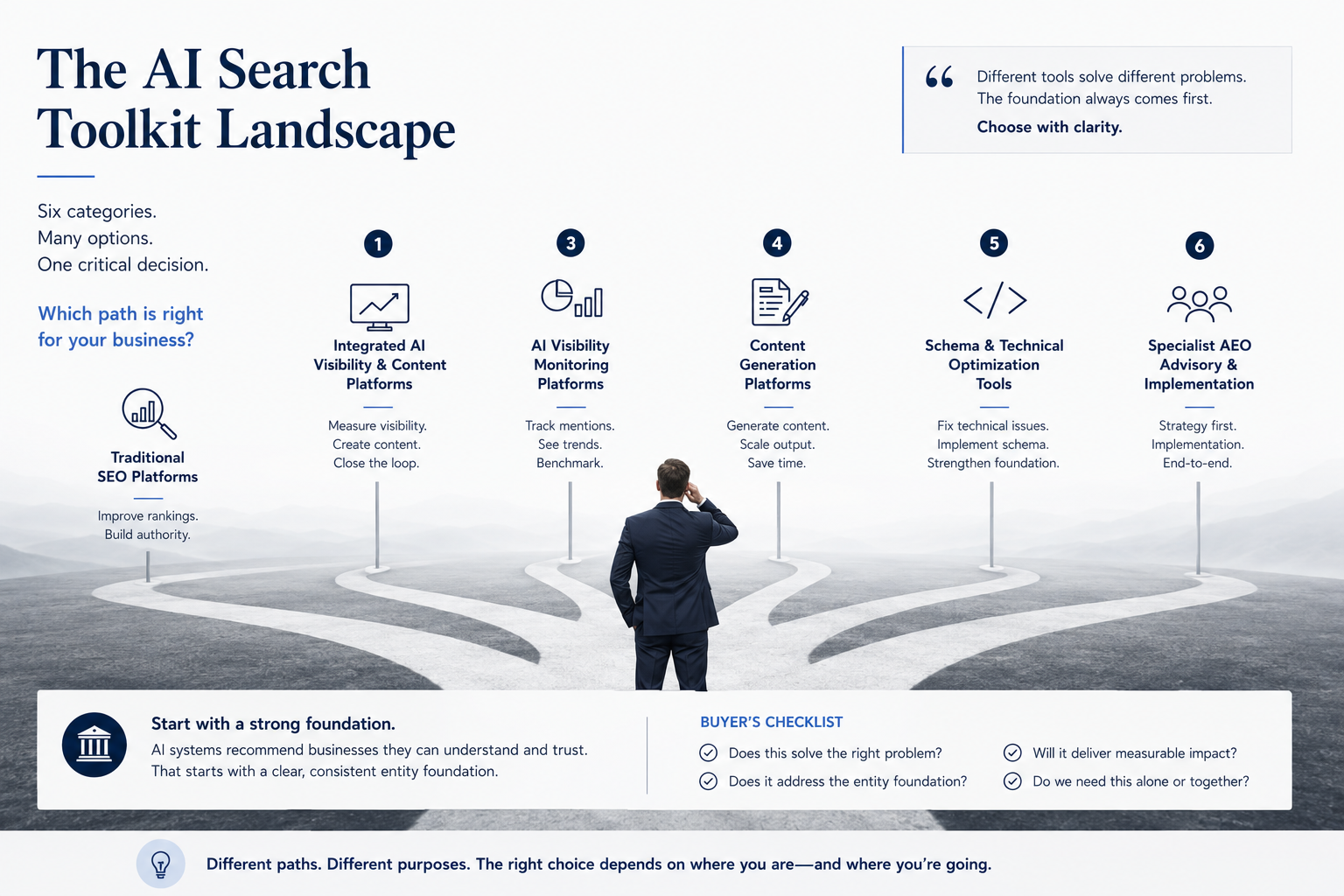
There are six broad categories in the field of optimizing AI search today. We’ll walkthrough each, including what it does well, where it falls short, and who it is genuinely built for.
Category 1: Traditional SEO Platforms
Examples: Ahrefs, Semrush, Moz, Screaming Frog.
These are mature, deeply capable platforms built for the traditional search ecosystem, now extending into AI visibility.
Traditional SEO platforms are appropriate for businesses with an established search presence that also need entity governance. Their AEO capability will likely be built out and hardened over time, but at the time of writing, using these platforms in parallel with specialist AEO work is the more reliable approach.
It is also worth stating plainly: traditional SEO work, particularly backlink and brand-mention building, is genuinely useful to AI search. Most AI engines that use retrieval-augmented generation still draw on the same web index that underpins traditional search. The two disciplines are not separate; they compound.
Category 2: Integrated AI Visibility &Content Platforms
Examples: AirOps, Conductor, Jasper's AEO suite, and a growing set of platforms collapsing visibility tracking and content production into one tool.
This is the newest and fastest-consolidating category. Where Category 3 measures and Category 5 produces, this group does both - tracking citation frequency across ChatGPT, Gemini, Perplexity, and Google AI Overviews, then routing the gaps it finds directly into bulk content workflows and CMS publishing.
These platforms represent where a meaningful part of the market is heading: consolidation of monitoring and execution into a single operating layer. That consolidation is a real efficiency gain. It does not, however, change what sits underneath it. A platform that ships content faster onto a site with duplicate entity references, unresolved schema conflicts, or no canonical organization entity is shipping more content into the same structural hole.
It's worth being precise about why generic content underperforms here. We don't think there's good evidence that AI models actively detect and penalize AI-generated or templated content as such. That claim circulates widely in AEO commentary but isn't well supported. We are absolutely open to being persuaded otherwise, but we haven’t seen the evidence yet. The real issue is simpler: a model can only cite what is specific and verifiable. Generic copy, however fast it ships, rarely contains the concrete facts, figures, or claims an AI system needs to construct a citable answer. Speed solves the production problem. It doesn't solve the substance problem. This is one of the reasons that we continue to believe in a human in the loop.
Category 3: AI Visibility Dashboards
Examples: Otterly.ai, Profound, Peec.ai, Mention, and the broader “Share of Voice in AI” category.
What they do: query major AI platforms on a scheduled basis and measure how often, and how favorably, your brand appears in responses. They produce share-of-voice metrics, competitor mention tracking, and trend charts over time.
This last point deserves its own note. Large, long-established enterprise brands often carry years of accumulated training-data citations and off-site brand signal; the kind of presence that was already part of the data these models were trained on. For those businesses, a visibility dashboard can be a sufficient starting point, because the off-site foundation is already largely in place. The calculation is different for a newer or growing B2B business without that accumulated footprint, where on-site infrastructure remains the primary lever available.
AI Visibility Dashboards are most useful for businesses that have already done the foundational entity and schema work and want to measure its effect over time. They are less useful as a starting point before that infrastructure exists, because you are measuring a house you have not yet built.
Clarity does not offer this as a service. Not because the service lacks value, but because measurement is a different discipline from governed implementation. The two work best in sequence.
Category 4: Automated Schema & SaaS Plugins
Examples: Yoast SEO, RankMath, Schema App, Merkle Schema Markup Generator, and various Webflow and WordPress plugins.
What they do: these services inject schema at scale, taking the headache out of curating schema over large websites.
Appropriate for large content sites and e-commerce operations where volume outweighs precision risk. Less appropriate as the sole schema strategy for high-consideration B2B businesses, where entity accuracy matters more than entity volume, and where a single duplicate @id or unresolved type conflict can do more harm to AI trust than no schema at all.
Category 5: AI-Optimized Content Generators
Examples: SurferSEO, Clearscope, Jasper, Copy.ai, and tools generating FAQ content, entity-optimized articles, or “AEO-ready” copy at scale.
Appropriate for high-volume content operations that already have entity infrastructure in place. Not a substitute for that structural work. Content built on a broken entity graph compounds the problem rather than solving it.
The same caveat applies here as in Category 2: this isn't about AI 'detecting' generated content, because there's no solid evidence for that. The principle is that generic, templated copy tends to lack the specific facts and original claims that make a page worth citing in the first place. A tool can produce fluent text at scale but it cannot manufacture the underlying specificity that gives that text citation value.
Category 6: AEO Specialist Services
This category splits into two distinct models, and the distinction matters more than it might first appear.
Outsourced Execution Services
Take a done-for-you approach, often tying their work directly to output metrics like lead volume rather than structural entity work. We looked at one such provider's own site as a case in point, auditing 56 of its pages directly. Eleven of those pages (1/5) carried no schema markup of any kind, including the page that specifically sells AI search visibility as a service. Not a single page on the site carried FAQ schema, despite a substantial blog operation built around buyer questions. And across the pages that did reference the company as an Organization entity, the name appeared in two different unlinked forms well over a hundred times, with only one instance anywhere on the site carrying the canonical entity ID required to tie those mentions together into a single, governed identity. None of this means the service doesn't generate leads we have no doubt that the case studies on lead volume are genuine. It means the entity infrastructure underneath the AI visibility claim is the same fragmented pattern we see across the category, including in providers that sell against it.
Governed entity infrastructure consultancy (this is what Clarity does)
Takes a narrower, deeper approach.
Appropriate for B2B and high-consideration businesses without 15+ years of accumulated off-site training-data citations; and where the on-site entity foundation is the primary lever available for AI recommendation readiness.
In Summary
Where to Start
Each of these categories does something real. The right question is not “which is best” but “where are you in your AEO maturity journey, and what does your specific gap require?”
If you’re confident that your underlying entity graph is whole, coherent, and comprehensive, you’re well placed to move straight to any of the categories above that match your remaining need. But the data we opened with is worth contemplating: when we audit sites in our own sector, the very businesses selling AI visibility, we consistently find the same structural patterns. Absent schema. Orphaned entity references. Missing FAQ markup. Pages with no canonical identity at all, etc.
Of course, if you’re still not sure what an entity graph is, please feel free to contact us.
Entity infrastructure is the foundation. Everything else in this landscape measures it, builds on top of it, or executes around it. Get the foundation right, and you can deploy content, run visibility dashboards, and scale execution with confidence that AI will actually cite what you publish.
Contact us today to find out where your site stands.