The Infrastructure Gap: Why the Tools That Claim to Solve AI Visibility Often Have the Weakest Entity Foundations
There is a difference between knowing what good entity infrastructure looks like and having it on your own site. The two are separate problems, and the gap between them is wider than most buyers assume.
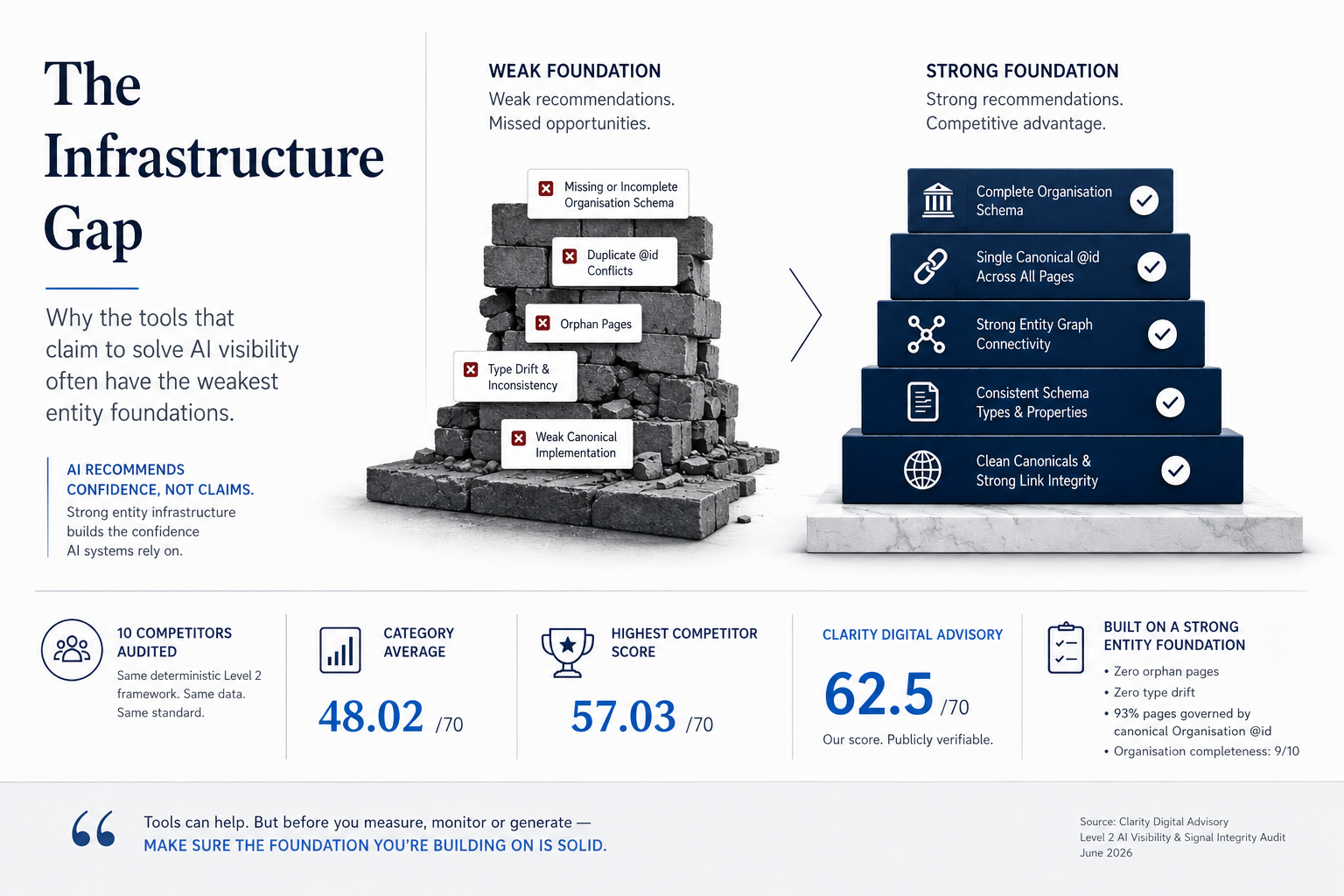
In June 2026 we ran our Level 2 audit, the same deterministic framework we apply to client engagements, against ten sites in our own competitive category. These are AI visibility platforms, schema tools, content engines and SEO suites. Several of them you will have seen advertised. We were not looking for an excuse to criticise anyone. We were testing a hypothesis: that the discipline of selling AEO and the discipline of governing your own entity graph are not the same skill, and that the second one is frequently neglected even by companies whose entire product is built on the first.
The data supported the hypothesis more clearly than we expected.
First, what "entity infrastructure" actually means
A quick definition, because the rest of this article depends on it.
When an AI system decides whether to recommend your business, it has to first work out who you are with confidence. It does that partly by reading structured data on your website: machine-readable code, invisible to human visitors, that states plainly what your organisation is called, what it does, where it operates, who runs it, and how all your pages connect back to that one organisation.
That code is built on a few foundations. **Schema** is the structured data itself, the markup that spells out the facts. An **entity** is the thing that schema describes, your business as a single, defined unit the AI can recognise. The **canonical identifier**, often written as an `@id`, is the unique address that ties every page on your site back to that one business entity, so the AI understands that your homepage, your services pages and your blog posts all belong to the same company. Your **entity graph** is the web of those connections taken together.
When this is done well, an AI reads your site and comes away with a clear, consistent picture of who you are. When it is done poorly, or not at all, the AI sees fragments it cannot confidently assemble. Pages with no link back to the business. Two conflicting definitions of the same company. An organisation profile with most of its facts missing. The site still looks finished to a human visitor. To a machine trying to decide whether to recommend you, the business is blurry or, in some cases, absent.
That is what we measured across ten sites. How clear, complete and consistent each company's own entity infrastructure was, using the same method we apply to clients.
What the audit measured
The framework scores a site out of 70 across two halves. The first half covers AI visibility: entity clarity, topical coherence, authority signals, structural readability and competitive position. The second covers signal integrity: structured data validity, crawl accessibility, canonical discipline, entity graph consistency and link integrity. Every audit produces a reproducibility hash, so the same site crawled the same way returns the same score. Nothing here depends on opinion. The numbers come straight from each site's published structured data and crawl-accessible pages. Our full audit measures buyer intent, comparison and objection prompts; and scores out of 100, but that wasn't necessary for this exercise.
What we found
Across the ten sites, the majority scored below 50 out of 70. The category average landed at 48.02. The highest competitor reached 57.03. None of them matched our own score.
A few individual findings are worth sitting with, because they describe the exact failure patterns these companies sell tools to prevent. We have kept them anonymous. Every figure below is drawn from publicly accessible data on each company's live site.
One platform whose core product is automated schema generation carried 112 duplicate `@id` conflicts on its own domain. Its Organisation profile was 30% complete. The canonical entity that should anchor the whole site was published on a blog subdomain rather than the main site, which left a large share of its commercial pages with no machine-readable link back to the business that owns them. This is the precise problem their product is designed to solve for paying customers.
One platform that markets AI brand governance had no canonical Organisation entity anywhere across its pages. There was nothing for an AI system to anchor to. The crawler could not even score Organisation completeness, because there was no stable Organisation node to evaluate.
One platform that publishes content under the banner that Answer Engine Optimisation is the successor to SEO had zero structured data across 100% of its pages. Not a single page on the site carried the markup that AI systems read to extract and attribute content.
One AI brand monitoring tool, the kind that tells you whether AI is citing you, had 91 of its 97 pages flagged as thin and indexable, including its homepage, and a link integrity score of zero out of five. The tool measures the symptom. The site demonstrates the condition.
Why this happens
None of this means these are bad companies or bad products. The likeliest explanation is mundane. These businesses sell to human marketing teams who find them through Google, LinkedIn, paid ads and word of mouth. Their sites are built and optimised for that journey, and it has worked well enough to raise capital and win customers. Entity graph governance was not the priority when those sites were built, and it accumulates technical debt quietly, with no visible symptom on the page. A site can look polished to a human visitor while an AI crawler struggles to work out who published it.
The people running these companies understand entity optimisation. In several cases they understand it deeply. Knowing the theory and having a governed, conflict-free, drift-resistant Organisation entity live on 93% of your pages are different achievements. One is a matter of expertise. The other is a matter of doing the implementation work and maintaining it. The gap between the two is the entire reason a specialist discipline exists.
Our own score, for comparison
Clarity Digital Advisory scored 62.5 out of 70 in the same audit. Zero orphan pages. Zero weakly-linked pages. Zero type drift. Zero pages without structured data. Entity graph consistency of 4.73 out of 5, and a canonical Organisation `@id` governing 93% of pages. Organisation completeness of 9 out of 10.
We publish this because we hold the view that any AEO provider should be able to demonstrate, on its own site, what it recommends to clients. The figure is independently verifiable. Run the same framework against our live site and you will reproduce it.
The honest caveat
These scores measure on-site structured data infrastructure. They do not measure total AI recommendability, and it would be an overreach to claim they do.
Companies with large off-site signal, meaning years of training data citations, Wikipedia entries, Wikidata presence and high-authority backlinks, can compensate for weak on-site schema in language models that lean primarily on training data. A well-established brand may be recommended confidently by an AI despite a thin entity graph, because the model already knows who they are from everything written about them elsewhere.
The on-site signals carry the most weight in retrieval-augmented generation, real-time AI agent searches and live crawls, which is the fast-growing slice of how buyers actually use these systems. And for a newer or growing B2B business without fifteen years of accumulated brand citations to fall back on, the on-site foundation is the primary lever available. If the model cannot read your entity graph and you are not yet famous enough for it to know you anyway, you are relying on a signal you do not have.
The distinction that matters
The takeaway is not that these tools are worthless. Many of them do their actual job well, and several solve real problems that have nothing to do with the gaps above. The takeaway is narrower. A weak on-site foundation does not make a monitoring tool inaccurate or a content tool ineffective. It means that anything built on top of that foundation is building on ground that has not been surveyed.
Measurement shows you the problem. Content sits on top of whatever exists underneath it. The foundation has to be right first, and getting it right is a discipline in its own right.
If you would like to see where your own entity foundation stands, the [Clarity Core Assessment](/services/clarity-core-assessment) produces a full, reproducible readiness score with a plain-English summary and a 90-day remediation plan. If you are evaluating providers more broadly, our [guide to choosing an AEO provider](/resources/aeo-buying-guide) sets out the ten questions worth asking any of them, including us.