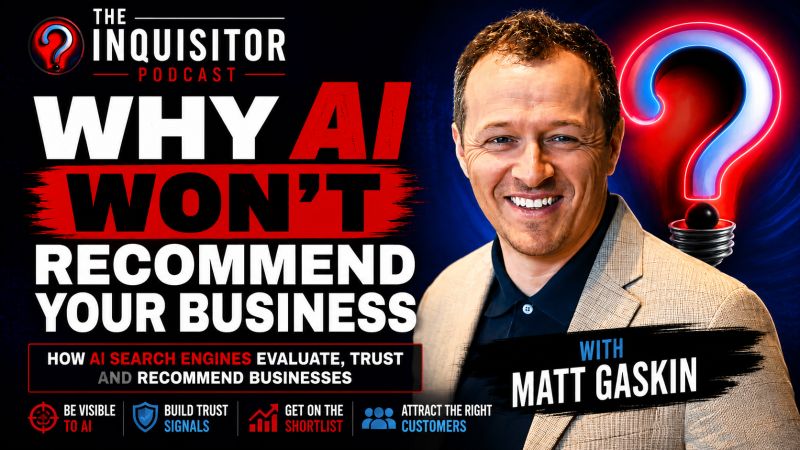
Our founder, Matt Gaskin, recently joined Marcus Cauchi for an episode of The Inquisitor Podcast to discuss why so many businesses are invisible to AI answer engines — and what they can actually do about it.
Among the insights covered:
- Why ranking on Google and being recommended by ChatGPT, Gemini, or Perplexity are completely different problems — and why a site can perform well on one while failing entirely on the other
- How unclear messaging creates "entity drift" — the condition where AI systems receive conflicting signals about who a business is, what it does, and who it serves, and quietly omit it from shortlists as a result
- Why smaller specialist firms can outperform much larger competitors in AI recommendation by being clearer, more specific, and more machine-readable
- What founders and commercial leaders should audit immediately: FAQs, buyer answers, case studies, and the technical structure that allows AI systems to extract and cite a business with confidence
- Why the problem isn't gaming an algorithm — it's whether your digital presence genuinely and unambiguously reflects the value your business provides
You can listen to the full episode here.
Some clarifications and corrections that we want to make
This episode was recorded in good faith and the core framework holds up. But on reflection, a few points deserve clarification, because thought leadership that can't self-correct isn't worth following. With that in mind we'd like to make the following addendums:
Can AI models crawl your site?
We said AI models can't crawl your site, and that's broadly true for most recommendation scenarios. Here's how we'd frame a more precise version: AI models trained on static datasets don't crawl in real time. However, retrieval-augmented tools like Perplexity do conduct live web retrieval, and Bing-backed models including Microsoft Copilot pull fresher index data than I implied. The practical point stands: most AI recommendations are derived from cached search engine data, not live site visits, but it's not a universal rule across all models.
Search engine crawl frequency
We cited four to six weeks as a typical crawl window. That's a reasonable midpoint estimate, but the reality varies significantly. A new small business site with low domain authority might wait considerably longer. A high-authority site with frequent updates can be crawled daily. The underlying point, that you can't expect overnight results, is correct. The specific window is not.
Our scoring thresholds
These figures: "broadly visible at 40"," edge-case recommended at 60", "default recommendation territory at 80" are our internal benchmarks within our own scoring model. They are not an industry-wide standard, because no such standard currently exists. We developed them through testing across multiple sites and models. Treat them as a working framework, not a published specification.
WordPress and AI readability
We said WordPress is "incredibly noisy for AI." That's too categorical. A better description is: out-of-the-box WordPress installations tend to generate bloated DOM output that creates unnecessary noise for AI parsers. We want to be clear: a well-configured WordPress site with a lightweight theme, proper schema implementation, and clean rendering can perform adequately. The structural advantage of platforms like Webflow is real, but it's a default difference, not an absolute one.
The Clarity Digital Advisory score of 82/100
We cited this as evidence the system works. It does work, but I should acknowledge the obvious: Clarity built the scoring tool and also scored Clarity's own site. That's grading your own homework. We stand behind the methodology, and client results will provide the independent validation that self-assessment cannot. We'll publish those as they become available.
"AI values time in the saddle"
The effect I was describing is real: you can't quickly reverse a poor digital history. But the mechanism I implied isn't quite right. AI models don't remember your site the way a human would. What's actually happening is twofold: search engine indices take time to reflect changes you make, and LLM training data has fixed cutoff dates that don't update in real time. The result is the same: rapid fixes don't produce rapid results,. but the reason is index latency and training cutoffs, not "AI memory".